Jump to a question in this guide
- What does a fuel-burning portable generator actually provide?
- How do the engine, alternator and inverter fit together?
- How does a piston engine turn fuel into rotation?
- Why can engine speed change when an appliance starts?
- How do rated output, maximum output and starting demand differ?
- What do the lights and protective stops actually tell you?
- Which electrical connection questions need an electrician?
- Why do cords, receptacles and appliances have separate limits?
- What makes outdoor location more than a distance measurement?
- Why do exhaust, cooling air and fuel need separate attention?
- What can an owner observe without creating a fault test?
- Why might a generator lose output or struggle to start?
- What should a service or performance report establish?
- How should storage and handover preserve the useful information?
- Work through a fictional refrigerator and outage plan
- What should be settled before the next outage?
- The engine supplies rotation; alternator and conversion equipment supply the intended electrical output.
- Rated continuing output, maximum output, starting demand and receptacle limits are different constraints.
- A CO shutoff does not permit enclosed use or replace home CO alarms; Health Canada retains outdoor6m advice and opening/exhaust precautions.
- A running engine or successful bench result does not approve the actual household connection or site.
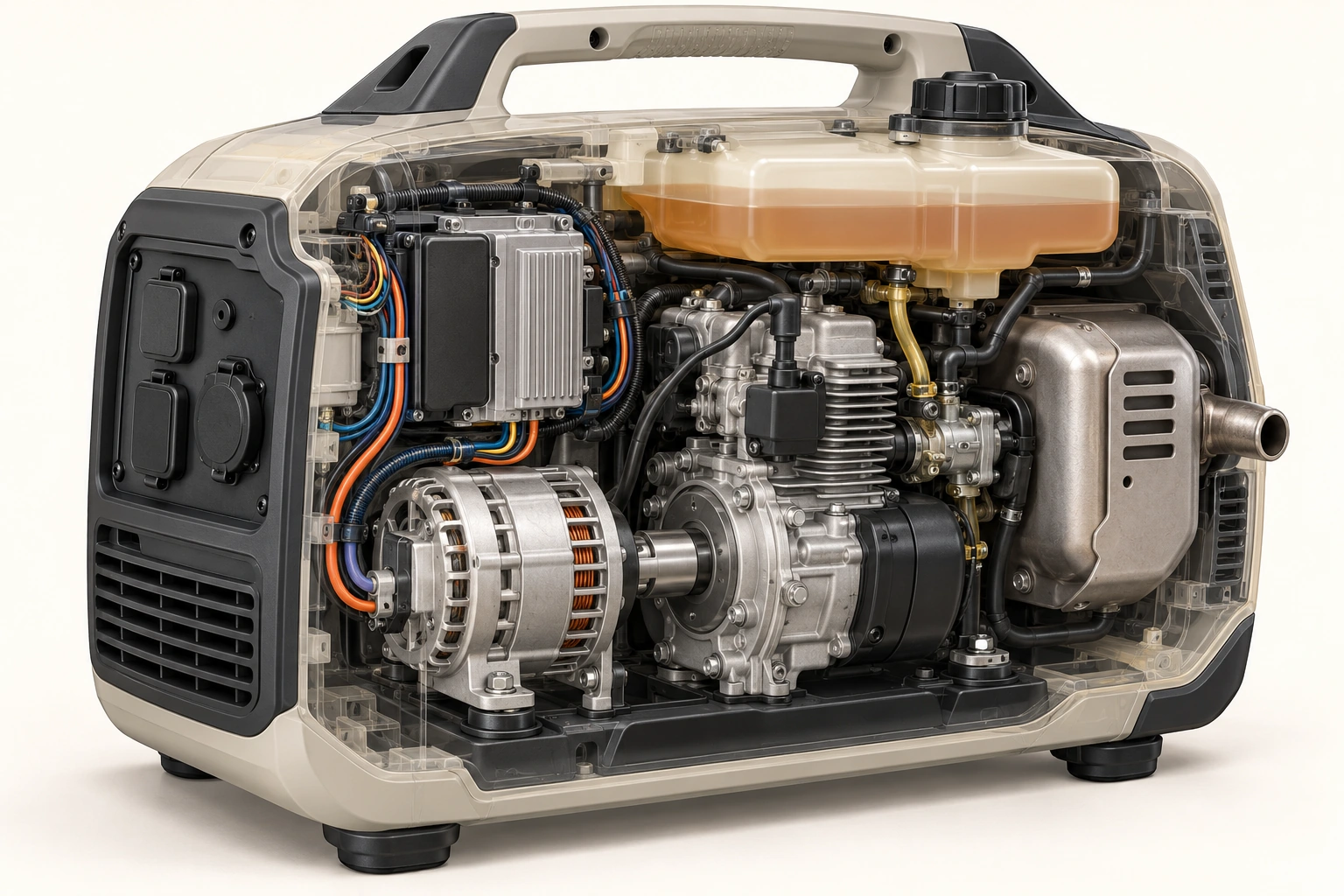
The engine’s shaft drives the round alternator; the separate module and receptacle side introduce electrical conversion. The tank and muffler have different supply and exhaust jobs.
About this illustration
Conceptual internal geometry; visible shaft links engine and alternator, while harnesses introduce conversion. No exact Honda design, measured output or product approval. This is a conceptual teaching model, not an assessment of your home.
9 picture lessons appear beside the questions in this guide. Use them to understand the explanation, then consider what it means for your home.
What does a fuel-burning portable generator actually provide?
A fuel-burning portable generator turns the energy in fuel into rotating motion, then into electrical output. It also produces heat, sound and exhaust. Those outputs exist together: an appliance receiving power does not mean the generator's exhaust or location is acceptable. The useful starting question is which household function needs support and whether the complete proposed arrangement can meet its electrical, operating and safety requirements.
Never run a fuel-burning generator indoors, in a garage or shed, or in a partly enclosed place. Health Canada says to operate it at least 6 metres from buildings, direct exhaust away from open windows and doors, and close windows and doors closest to or downwind from it. A CO shutoff does not make indoor use permissible or replace home CO alarms. If a home CO alarm sounds, leave immediately and call emergency services from outside.
Here the distinct subject is an owner-managed portable engine-generator: its parts, output limits, protection, location, storage and service questions. The standby-generator handover guide owns an installed automatic system and transfer-equipment evidence. The outage guide owns household priorities and alternatives. A portable unit is not automatically an acceptable substitute for that installed system, and the presence of a receptacle does not authorize connection to house wiring.
The detailed examples use Honda's named EU2200i/EU2200i Companion manual with a 2020 copyright and a separate Honda inverter explanation. Other engines, controls, fuel systems and electrical arrangements differ. These sources explain mechanisms without approving a Canadian product or installation. Keep the actual model, serial range and matching instructions with any assessment; do not operate unfamiliar equipment by copying the generated cutaway or an old manual for a similar-looking machine.
From fuel to useful electrical output
The engine makes rotation; the alternator makes alternating electrical output, and the named inverter architecture converts it through DC before supplying AC. Exhaust is a separate engine output.
Numbers identify the parts explained below.
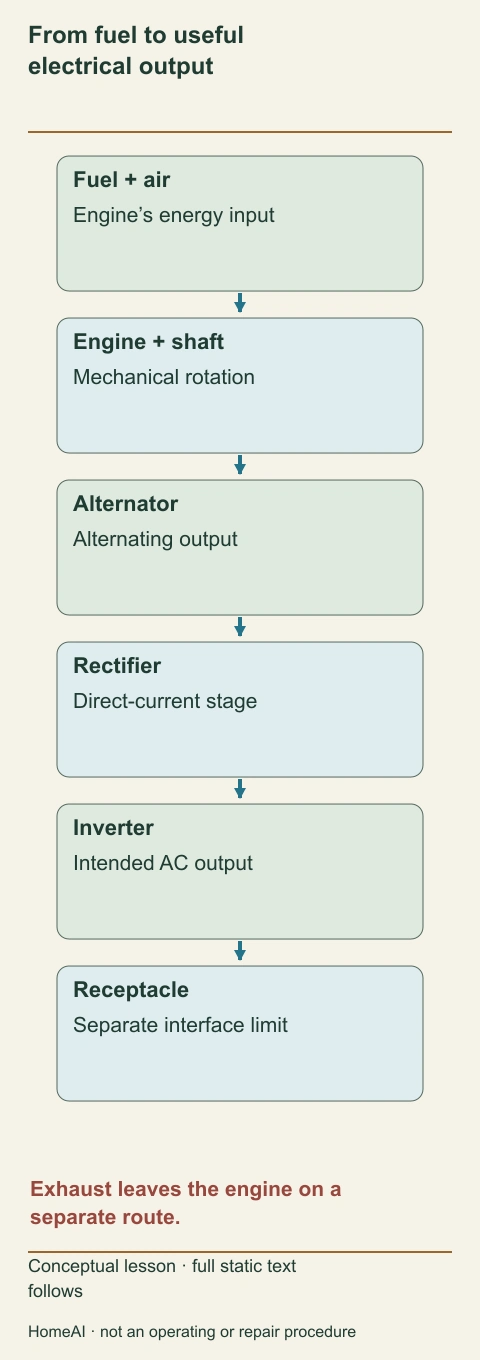
- Fuel and air
Supply the engine’s combustion process.
- Engine and shaft
Turn released fuel energy into rotation.
- Alternator
Uses rotation to generate alternating electrical output.
- Rectifier and inverter
Convert AC to DC and back to the intended AC output.
- Receptacle
Provides the intended electrical interface, within its separate limits.
What does this illustration leave out?
Conceptual named architecture; no internal wiring, capacity, output quality or complete installation is assigned. This illustration explains an idea. It is not an installation guide.
Which generator architecture and actual output requirements apply to your proposed appliance?
Explore this with HomeAI ↗Opens an editable question. Nothing is sent until you choose to send it.From fuel to useful electrical output
The engine makes rotation; the alternator makes alternating electrical output, and the named inverter architecture converts it through DC before supplying AC. Exhaust is a separate engine output.
- Fuel and air
- Supply the engine’s combustion process.
- Engine and shaft
- Turn released fuel energy into rotation.
- Alternator
- Uses rotation to generate alternating electrical output.
- Rectifier and inverter
- Convert AC to DC and back to the intended AC output.
- Receptacle
- Provides the intended electrical interface, within its separate limits.
Figure scope: Conceptual named architecture; no internal wiring, capacity, output quality or complete installation is assigned.
A useful question: Which generator architecture and actual output requirements apply to your proposed appliance?
Full wording shown in this figure
- From fuel to useful
- electrical output
- Fuel + air
- Engine’s energy input
- Engine + shaft
- Mechanical rotation
- Alternator
- Alternating output
- Rectifier
- Direct-current stage
- Inverter
- Intended AC output
- Receptacle
- Separate interface limit
- Exhaust leaves the engine on a
- separate route.
- Conceptual lesson · full static text
- follows
- HomeAI · not an operating or repair procedure
How do the engine, alternator and inverter fit together?
The engine supplies mechanical rotation. An alternator uses that rotation to generate alternating electrical output. In an inverter generator, that output passes through electrical conversion stages before reaching the intended receptacles. Fuel does not travel through the inverter, and engine exhaust does not belong in the electrical output path. Seeing those separate routes makes a compact enclosed machine easier to understand without removing any of its actual covers.
Honda's explanation describes an alternator producing high-frequency alternating current, a rectifier converting it to direct current, and an inverter producing the intended alternating-current output. Alternating current changes direction; direct current has one direction. This is a description of the named architecture, not a claim that every portable generator contains an inverter or that every inverter produces identical output under every load.
A conventional generator and an inverter generator can therefore share an engine-to-alternator mechanical relationship while controlling electrical output differently. Ask which type is actually proposed, what the manufacturer publishes for the intended appliances, and what protections apply. An advertising phrase about clean power does not resolve a damaged cord, an inappropriate connection, an overloaded receptacle or an appliance manufacturer's compatibility requirements.
The whole-machine picture introduces the components; the precise native route supplies the connection order. The compact arrangement inside a product may conceal junctions even in a transparent illustration. It is an explanation to discuss with a supplier or service professional, not a wiring drawing or permission to explore the real enclosure. Internal electrical access, conversion-module repairs and modifications belong to appropriately qualified service personnel.
Engine rotation and electrical conversion
The engine’s shaft drives the round alternator; the separate module and receptacle side introduce electrical conversion. The tank and muffler have different supply and exhaust jobs.
Numbers identify the parts explained below.
- Engine
Supplies mechanical rotation.
- Alternator
Generates electrical output from that rotation.
- Inverter module
A separate electrical-conversion stage.
- Muffler
Belongs to combustion exhaust, not electrical supply.
What does this illustration leave out?
Conceptual internal geometry; visible shaft links engine and alternator, while harnesses introduce conversion. No exact Honda design, measured output or product approval. This illustration explains an idea. It is not an installation guide.
Where does mechanical rotation become electrical output on the actual model?
Explore this with HomeAI ↗Opens an editable question. Nothing is sent until you choose to send it.How does a piston engine turn fuel into rotation?
In a spark-ignition four-stroke engine, a piston moves back and forth in a cylinder. A connecting rod links the piston to an offset part of the crankshaft, turning that movement into rotation. Intake, compression, combustion and exhaust are separate parts of the repeating cycle. The spark initiates combustion; the fuel's released energy supplies the force. A spark plug is not the source of all the generator's electrical output.
During intake, the open inlet route lets the cylinder receive its charge. Compression reduces the space occupied by that charge. Combustion produces expanding hot gases that push the piston, and the exhaust stage sends spent gases into the exhaust system. The DENSO automotive teaching chapter supports this basic physics. Its fuel-injection examples, timing detail and numerical compression examples are not specifications for the portable Honda engine or another household generator.
Fuel delivery, air supply, ignition, compression and the driven load can all matter when an engine behaves differently. A difficult start is therefore not a diagnosis of a carburetor, spark plug or alternator. A report of the first changed behaviour, storage history and actual control indication gives the service provider a more useful starting point than a request for one guessed replacement part.
Do not remove a spark plug, make an ignition trial, alter a governor or open the fuel system to prove this lesson. The named manual contains procedures for different abilities and service scopes; this guide deliberately supplies no engine test or repair sequence. A conceptual piston close-up can teach the relationship while the real equipment remains assembled, cool and handled only according to its applicable instructions.
Piston movement becomes shaft rotation
A connecting rod links the piston to the offset crank, so back-and-forth piston movement can drive rotation. Intake and exhaust passages have separate functions.
Numbers identify the parts explained below.
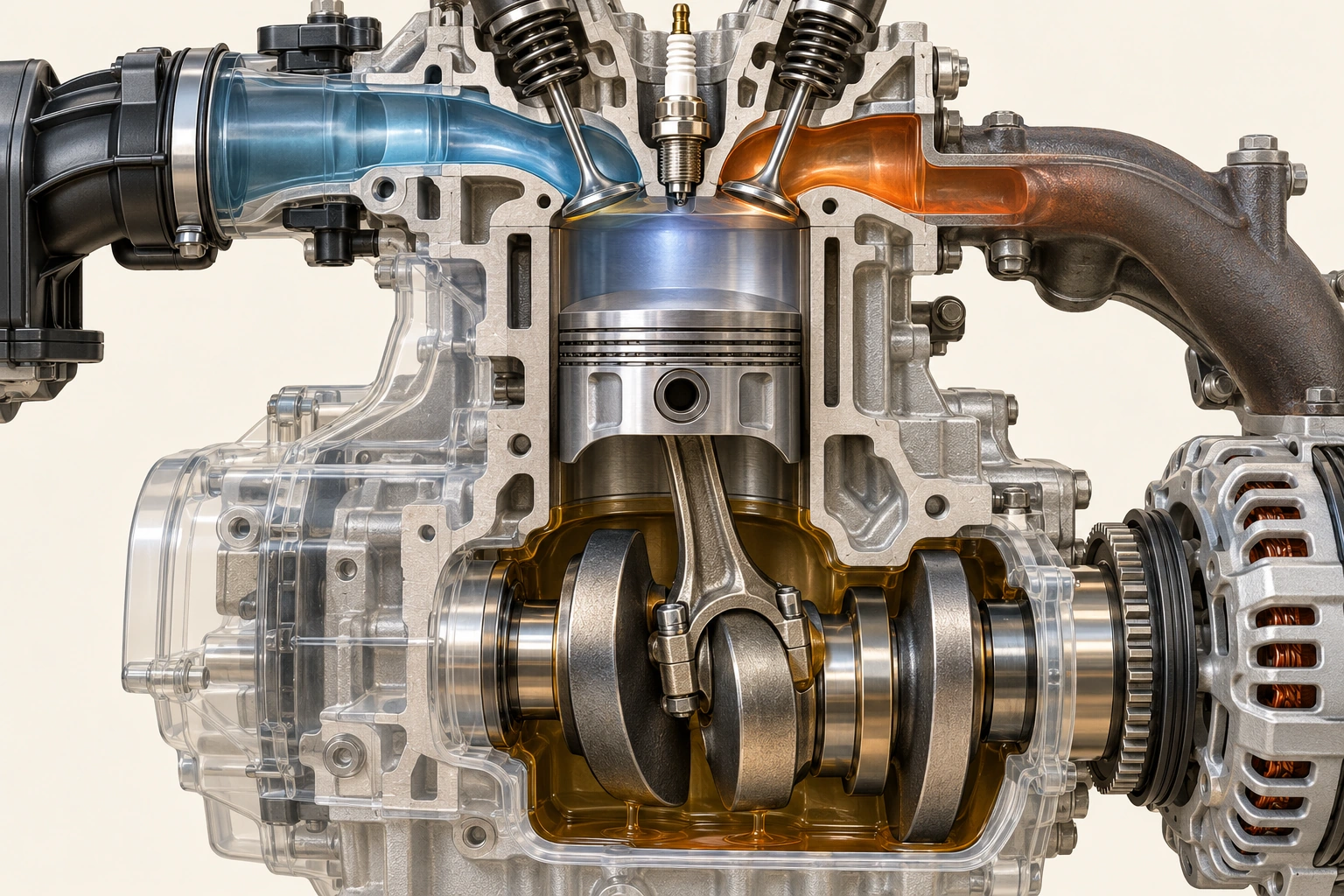
- Piston
Moves within the cylinder.
- Connecting rod
Links the piston to the offset crank.
- Crankshaft
Provides the rotating mechanical output.
- Head passages
Provide separate intake and exhaust routes.
What does this illustration leave out?
No exact Honda construction or cycle phase is assigned; no owner access, compression or ignition test. This illustration explains an idea. It is not an installation guide.
Which engine and output functions were actually assessed when the equipment struggled?
Explore this with HomeAI ↗Opens an editable question. Nothing is sent until you choose to send it.Why can engine speed change when an appliance starts?
An electrical load places a demand on the generator. In the named Honda inverter system, a control can adjust engine speed as that demand changes. When a load is removed the engine can slow; when an appliance is connected or starts, the system responds to the increased demand. This explains a possible change in sound without making a sound recording a measurement of voltage, frequency or available power.
The Honda manual's Eco Throttle function has operating conditions and limitations, including appliances with substantial starting demand or momentary use. Its existence is not a universal instruction to use one switch setting for every job. The actual manufacturer and appliance requirements determine the operating arrangement; a generic efficiency claim cannot resolve a motor that fails to start or a protection device that repeatedly interrupts output.
Separate an expected load response from a newly reported fault. Useful observations already available may include whether an appliance was starting, whether an overload indicator appeared, whether output stopped while the engine continued, and whether the event followed a storage period. Do not keep reconnecting the same problematic appliance to create a repeatable demonstration. Stop abnormal use and obtain an appropriate assessment.
Compare three situations: little electrical demand, an appliance beginning operation, and continuing demand. The engine’s response to them helps explain why starting and continuing operation are different questions; this description assigns no speed, voltage or fuel-saving measurement. A professional may need the generator, appliance and supply accessories assessed together rather than declaring the generator faulty from one change in engine note.
How do rated output, maximum output and starting demand differ?
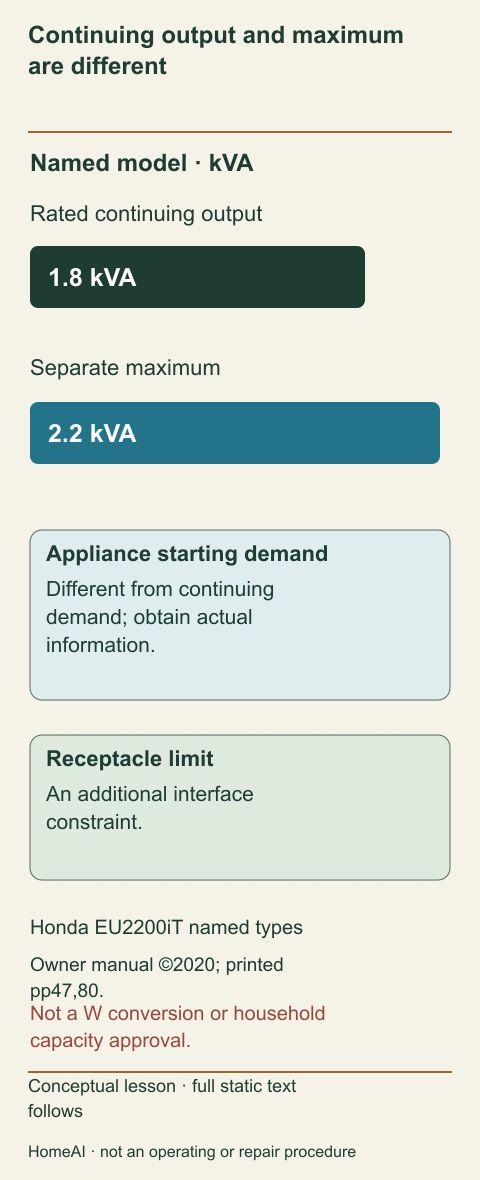
A generator's rated output describes its intended continuing capacity under the manufacturer's stated conditions. A maximum output is a different limit, not a promise that this higher number can supply the household indefinitely. The named Honda manual lists 1.8 kVA rated and 2.2 kVA maximum for its specified EU2200iT types. These are dated product examples, not a recommendation or a capacity assigned to the conceptual picture.
The manual also explains that many motorized appliances need more power while starting than during established operation. A refrigerator's quiet running state and its compressor starting event therefore pose different demand questions. Obtain the appliance manufacturer's information and any appropriate professional assessment. Do not multiply an invented surge factor by a catalogue wattage and treat the result as a confirmed household operating plan.
Keep units intact. VA, or volt-amperes, describes apparent power; W, or watts, describes real power. They should not be silently substituted in a comparison that has not established the relevant load conditions. A receptacle's current marking is another constraint, not extra generator capacity. Several outlet openings do not multiply the power available from the engine-generator and its conversion equipment.
A useful planning sheet lists the actual device, continuing rating, starting information, operating priority and unresolved requirement. Leave unknowns visibly unknown rather than filling them with estimates that look measured. The supplier or electrician can then explain the supported combinations and connection arrangements. This guide gives no load-test method, universal spare-capacity percentage or guarantee that a medical or essential household function will remain available.
Continuing output and maximum are different
The named manual gives1.8kVA rated and2.2kVA maximum. The higher label is not a continuing household capacity, and neither settles a motor’s starting demand or a receptacle limit.
Numbers identify the parts explained below.
- Rated1.8kVA
Named model’s continuing output under its conditions.
- Maximum2.2kVA
A separate manufacturer limit, not indefinite supply.
- Appliance start
May create a different demand from continuing operation.
- Receptacle limit
Constrains its interface without adding generator capacity.
What does this illustration leave out?
Dated EU2200iT type example only; no W conversion, operating-duration promise or supported appliance combination. This illustration explains an idea. It is not an installation guide.
What are the actual appliance’s continuing and starting requirements, in matching units?
Explore this with HomeAI ↗Opens an editable question. Nothing is sent until you choose to send it.Continuing output and maximum are different
The named manual gives1.8kVA rated and2.2kVA maximum. The higher label is not a continuing household capacity, and neither settles a motor’s starting demand or a receptacle limit.
- Rated1.8kVA
- Named model’s continuing output under its conditions.
- Maximum2.2kVA
- A separate manufacturer limit, not indefinite supply.
- Appliance start
- May create a different demand from continuing operation.
- Receptacle limit
- Constrains its interface without adding generator capacity.
Figure scope: Dated EU2200iT type example only; no W conversion, operating-duration promise or supported appliance combination.
A useful question: What are the actual appliance’s continuing and starting requirements, in matching units?
Full wording shown in this figure
- Continuing output and maximum
- are different
- Named model · kVA
- Rated continuing output
- 1.8 kVA
- Separate maximum
- 2.2 kVA
- Appliance starting demand
- Different from continuing
- demand; obtain actual
- information.
- Receptacle limit
- An additional interface
- constraint.
- Honda EU2200iT named types
- Owner manual ©2020; printed
- pp47,80.
- Not a W conversion or household
- capacity approval.
- Conceptual lesson · full static text
- follows
- HomeAI · not an operating or repair procedure
Capacity labels answer different questions
- Rated outputUseful meaning: Continuing manufacturer capacity under stated conditionsWhat it does not establish: Suitability of every appliance start or connection
- Maximum outputUseful meaning: A separate manufacturer limitWhat it does not establish: An indefinite household supply
- Receptacle ratingUseful meaning: A limit at a particular interfaceWhat it does not establish: Extra engine-generator capacity
Named Honda2020 example; retain units and actual product conditions.
What do the lights and protective stops actually tell you?
An output indication, overload alarm and oil-related stop answer different questions. In the named manual, an output light indicates electrical production, an overload condition can interrupt output while the engine continues, and the Oil Alert system can stop the engine to protect it against insufficient oil. The same manual says an oil/check indication can also accompany a CO-system stop. One illuminated lens is not a universal fault code.
A CO shutoff responds to conditions around its sensor. Health Canada recommends choosing a generator with this feature while explicitly retaining outdoor operation and home CO alarms. It does not certify clean air at a neighbour's opening or inside a bedroom. A shutdown is a reason to stop and resolve the situation, not an invitation to defeat the sensor or repeatedly restart until the light stays off.
Read the actual model's indicator names and the event that preceded them. Distinguish a protective stop, a sensor fault or end-of-life indication, and a different engine or electrical problem. The service provider needs that account together with model identity. Do not replace those distinctions with generic red-means-overload or green-means-safe captions. Colours alone do not establish the equipment's present readiness.
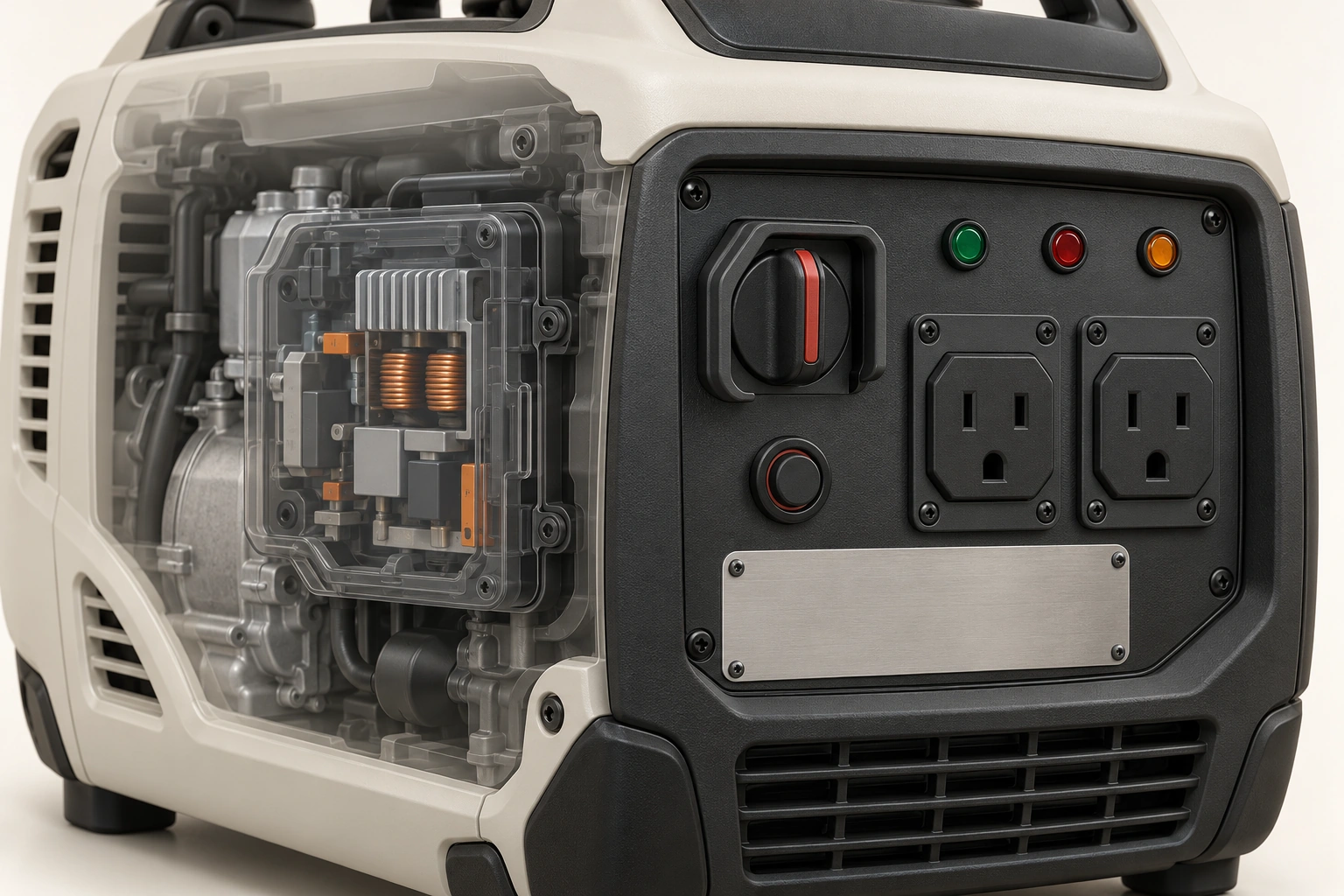
The close-up deliberately shows an inactive generic control face rather than a successful operating result. No generated light pattern validates a real unit. Keep all protection in place, and seek qualified service for abnormal or repeated interruption. This guide does not provide a reset sequence, sensor bypass, oil-fill recipe or troubleshooting trial around an exhaust source.
Indicators report different functions
The receptacles provide electrical interfaces; separate lenses and controls can concern output, overload or other protection. Their meaning comes from the exact manual.
Numbers identify the parts explained below.
- Receptacle
The intended output interface.
- Indicator lenses
Different model-specific reporting functions.
- Protective control
Separate from an observation of usable power.
- Product identity
Needed to interpret the actual panel.
What does this illustration leave out?
Unlit illustrative face; colours and three-slot geometry establish no status, Canadian listing, live output or exact Honda code. This illustration explains an idea. It is not an installation guide.
Which indicator name and event does the actual manual identify?
Explore this with HomeAI ↗Opens an editable question. Nothing is sent until you choose to send it.Protective functions are not interchangeable
- Output indicatorJob: Reports intended electrical production in the named modelOwner decision: Does not certify air, site or complete wiring
- Overload protectionJob: Can interrupt output under relevant conditionsOwner decision: Stop abnormal use and resolve the cause
- CO shutoffJob: Responds to conditions near its sensorOwner decision: Outdoor requirements and home CO alarms remain
No reset, bypass or repeat-fault trial supplied.
Which electrical connection questions need an electrician?
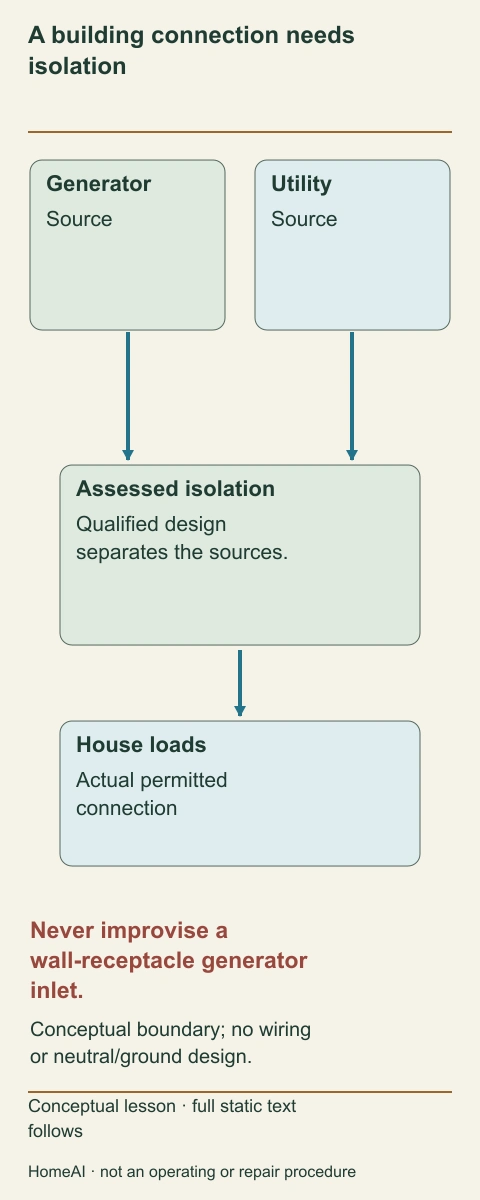
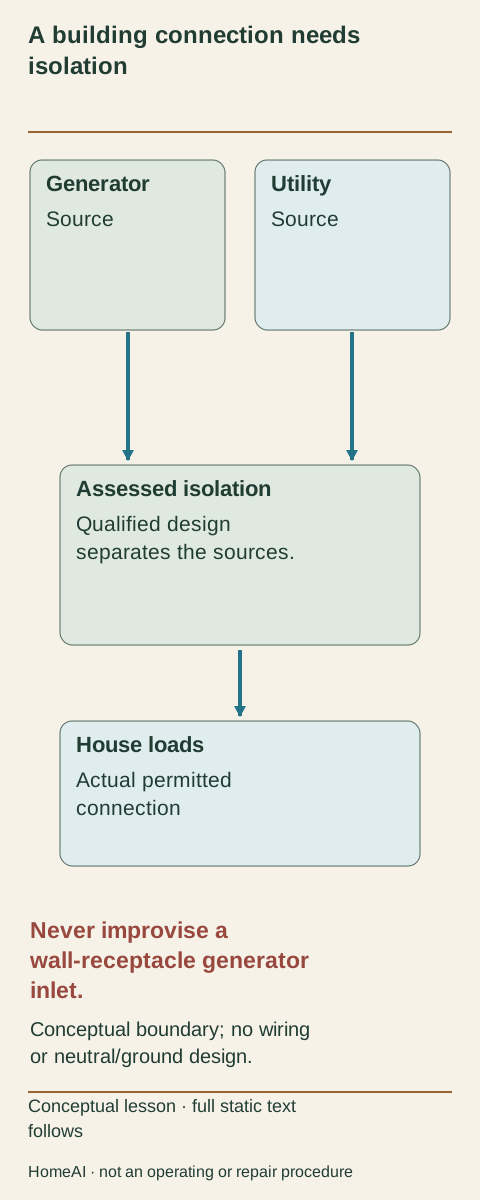
Supplying an appliance through a manufacturer-permitted arrangement and supplying installed house wiring are different projects. A building connection must isolate generator power from utility power. The named Honda manual warns that an improper connection can backfeed utility lines and endanger people working on them. An outage does not make those lines a suitable receiving route for a portable generator.
Do not connect a generator to a household wall receptacle, make a two-male-ended cord, bypass transfer equipment or improvise a connection at a panel. Have a qualified electrician and the relevant authority resolve the actual equipment, isolation, grounding and bonding, protection and permits. This guide neither designs that arrangement nor declares a particular neutral configuration suitable for every Canadian property.
Grounding language is especially easy to overgeneralize. The named Honda manual describes its own floating-neutral arrangement and directs users to qualified local advice. A visible ground terminal does not mean an owner should add a rod or modify a neutral connection. Different generator designs and intended uses can change the question; the exact manual and actual installation assessment must remain together.
Keep the electrical scope in writing: which loads and connection are addressed, which equipment is included, and which findings remain outstanding. A receipt for the generator alone does not document a house connection. The installed standby guide provides the broader handover questions; here the safe decision is to resolve the proposed portable arrangement before relying on it, rather than infer approval from a cord that physically fits.
A building connection needs isolation
An assessed building connection separates utility and generator sources through suitable isolation. A wall receptacle is not an improvised generator inlet.
Numbers identify the parts explained below.
- Generator source
One possible supply under an assessed arrangement.
- Utility source
Must not receive unintended generator backfeed.
- Isolation equipment
Separates sources in the qualified design.
- House loads
Need the actual permitted connection and capacity scope.
What does this illustration leave out?
Conceptual boundary, not a wiring diagram, device selection, neutral/ground design or electrical approval. This illustration explains an idea. It is not an installation guide.
Which qualified person and authority have resolved the actual proposed building connection?
Explore this with HomeAI ↗Opens an editable question. Nothing is sent until you choose to send it.A building connection needs isolation
An assessed building connection separates utility and generator sources through suitable isolation. A wall receptacle is not an improvised generator inlet.
- Generator source
- One possible supply under an assessed arrangement.
- Utility source
- Must not receive unintended generator backfeed.
- Isolation equipment
- Separates sources in the qualified design.
- House loads
- Need the actual permitted connection and capacity scope.
Figure scope: Conceptual boundary, not a wiring diagram, device selection, neutral/ground design or electrical approval.
A useful question: Which qualified person and authority have resolved the actual proposed building connection?
Full wording shown in this figure
- A building connection needs
- isolation
- Generator
- Source
- Utility
- Source
- Assessed isolation
- Qualified design
- separates the sources.
- House loads
- Actual permitted
- connection
- Never improvise a
- wall-receptacle generator
- inlet.
- Conceptual boundary; no wiring
- or neutral/ground design.
- Conceptual lesson · full static text
- follows
- HomeAI · not an operating or repair procedure
Why do cords, receptacles and appliances have separate limits?
The generator, its individual receptacles, the connecting equipment and the appliance each have requirements. The smallest-looking part can still be essential: damaged insulation or an unsuitable plug cannot be made acceptable by choosing a larger generator. The named manual requires suitable, undamaged appliances and cords and says not to exceed the generator's or the individual receptacle's rating.
Length, conductor size, intended environment and load belong in an actual cord-selection assessment. This guide supplies no universal extension-cord length or wire-size chart. A route across a doorway, wet ground or vehicle path also introduces practical questions that a power calculation does not answer. Do not pinch a cord through a closing window to avoid resolving the complete arrangement.
Parallel ports are another distinct interface. Some named models can operate together only with specified compatible models, serial ranges and manufacturer-approved equipment. Two machines with similar-looking sockets are not automatically compatible. This guide does not reproduce a parallel connection sequence or count two nameplate maxima as usable household capacity. Such a proposal needs its complete matched instructions and appropriate advice.
For an owner preparing questions, record actual accessory identities and the intended appliance. Ask what the arrangement permits and what it excludes. If a plug, cord or appliance becomes damaged or behaves abnormally, stop using it rather than try alternate adapters to locate a workable combination. Electrical inspection and appliance service can answer complementary questions; neither is replaced by the generator's status light.
What makes outdoor location more than a distance measurement?
Health Canada's at-least-6-metre generator advice belongs with its other directions: outdoor operation, exhaust away from openings, closed nearby or downwind doors and windows, and people and pets kept away. A distance measured from one wall does not account for another building, a vent around a corner or an occupied neighbouring space. The whole location needs to support the current safety advice and the actual manual.
The Honda manual separately discusses heat, cooling airflow and the danger of operating in enclosures. Its shorter numerical clearance for fire and cooling is not adopted as an alternative to Health Canada's CO separation advice. These requirements concern different hazards. Do not use the smaller number to claim that a generator beside a doorway is acceptable, or use the larger number to infer every other condition has been satisfied.
Weather can defeat a plan that looked workable on a dry afternoon. The named model prohibits wet operation and warns against rain and snow; moving it into a garage or covering it with an improvised box creates another hazard. Obtain product-specific advice and a viable alternative before an emergency. A forecast is not permission to operate unsuitable equipment, and this guide designs no enclosure or weather cover.
The yard picture is intentionally not a scaled placement drawing. It shows a separate outdoor source and building openings so the reader can identify questions. It establishes no distance, property-line permission, noise compliance or approved location. If the available site cannot support the complete requirements, the useful outcome may be a different backup strategy or leaving for a suitable alternative location.
Exhaust location and openings belong together
The generator is a separate outdoor exhaust source; the house’s windows, doors and vents are relevant receiving openings. Distance and exhaust direction need the complete current advice.
Numbers identify the parts explained below.

- Outdoor source
Produces exhaust and heat during operation.
- House openings
Can matter to where combustion products travel.
- Open-air space
Not a substitute for actual site assessment.
- Alternative plan
Needed when the location or weather cannot support use.
What does this illustration leave out?
A different generic open-frame generator illustrates the site question. No scale, measured6m distance, weather solution, property-line permission or approved location. This illustration explains an idea. It is not an installation guide.
Can the actual site meet HC outdoor6m/opening/exhaust advice and the complete product requirements?
Explore this with HomeAI ↗Opens an editable question. Nothing is sent until you choose to send it.Why do exhaust, cooling air and fuel need separate attention?
Exhaust carries combustion products out of the engine. Cooling air carries away heat from equipment surfaces and passages. Fuel supplies the engine's energy. These routes interact through heat and location, but they are not interchangeable. Keeping one grille clear does not prove exhaust is directed safely, and a machine that appears cool from a distance can still have a dangerously hot muffler.
Do not enclose the generator, block its openings or modify covers to reduce sound. The named Honda design relies on an intended cooling arrangement. A homemade sound box changes conditions the product was not assessed here to tolerate. A quieter-seeming site can therefore be less suitable, especially if it confines exhaust or cooling air. Discuss noise and site options without turning the illustration into an enclosure plan.
Health Canada says to stop the generator and let it cool before refuelling. Gasoline vapour and hot equipment are an ignition concern; refuelling is not a quick task to squeeze into a running outage cycle. Follow the exact fuel and handling instructions. This guide supplies no filling level, additive mixture, siphoning procedure or reason to keep an engine running while handling fuel.
The practical planning question is how the household will manage a legitimate interruption, cooling and fuel needs without losing an essential function. Record that dependency before relying on the machine. A nominal tank runtime is conditional on the actual product and load; it does not establish an unattended overnight plan, a medical-device backup duration or the availability of fuel during a regional emergency.
What can an owner observe without creating a fault test?
An owner can preserve ordinary information already available: the model plate, matching manual, reported hours, service documents, storage account and the circumstances of a changed event. From a safe position and within the product instructions, visible damage, an obstructed area or a missing label may identify a question. Do not approach hot equipment, inhale exhaust or remove covers to improve the record.
For a reported loss of power, distinguish what stopped. The engine stopping, electrical output stopping while the engine continues, and one appliance stopping are different observations. Indicator wording and the timing of an appliance start may help a qualified provider choose an assessment. A phone video is only worth retaining if already made safely; it is not a reason to stage another abnormal event.
Avoid owner tests involving live receptacles, open electrical panels, intentional overload, running out of fuel, deliberate CO exposure or repeated protective shutdowns. A low consumer CO display also cannot certify an outdoor site or a complete indoor plan. If a home CO alarm sounds, leave and call emergency services from outside rather than investigate which machine or appliance produced it.
Useful records are specific and modest: date, what was already happening, what was seen, and what remains unknown. For example, output stopped as the refrigerator started is more informative than generator broken. It still does not identify the cause. Good observation improves the service question while leaving hazardous diagnosis and the actual permission to resume with the appropriate professionals.
Why might a generator lose output or struggle to start?
The named manual lists several possible causes for a no-start event, including fuel and control conditions, oil-related protection, ignition or fuel-system problems and the CO system. Reduced engine performance can have air-supply, fuel or internal causes. These possibilities explain why a replacement part chosen from one symptom can miss the problem. They are not a household checklist to work through by repeated cranking or cover removal.
Loss of electrical output can involve the connected load, a circuit protector, the conversion equipment or the generator itself. A motor's starting demand can be relevant even when its continuing rating seems modest. The correct assessment separates the appliance and connection from the generator's output and protection. A running engine is evidence of engine operation at that moment, not proof of sound receptacles or usable voltage.
Storage creates another alternative explanation. The Honda manual describes fuel deterioration and deposits as possible contributors to later starting or running problems, with conditions varying by fuel blend and storage environment. Do not translate its earliest possible deterioration period into a universal expiry date. Preserve what was actually stored, for how long, and what preparation was documented; uncertainty is preferable to a guessed cause.
Ask the provider to state which possibilities were assessed, what was found and which remain unresolved. A quotation for carburetor service is not itself a finding that fuel caused the event. Equally, one successful service-bench run may not address the household's proposed load or site. The follow-up should match the original question rather than expand a limited result into complete backup readiness.
What stopped, and what remains to assess?
A changed event becomes more useful when the report says whether the engine, output or appliance stopped. Each branch leads to a defined assessment rather than an assumed replacement part.
Numbers identify the parts explained below.
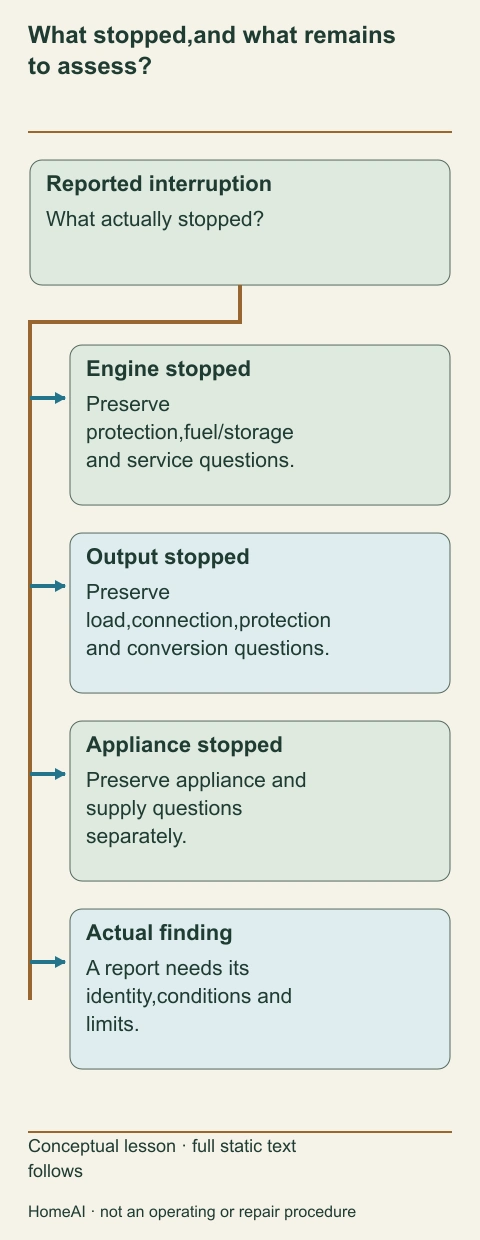
- Engine stopped
Preserve protection, fuel/storage and service questions.
- Output stopped
Preserve load, connection, protection and conversion questions.
- Appliance stopped
Preserve appliance and supply questions separately.
- Actual finding
A report needs its identity, conditions and limits.
What does this illustration leave out?
Conceptual service questions; no reset trial, diagnosis, live measurement or owner troubleshooting sequence. This illustration explains an idea. It is not an installation guide.
Which branch is supported by the original account and actual recorded indicators?
Explore this with HomeAI ↗Opens an editable question. Nothing is sent until you choose to send it.What stopped, and what remains to assess?
A changed event becomes more useful when the report says whether the engine, output or appliance stopped. Each branch leads to a defined assessment rather than an assumed replacement part.
- Engine stopped
- Preserve protection, fuel/storage and service questions.
- Output stopped
- Preserve load, connection, protection and conversion questions.
- Appliance stopped
- Preserve appliance and supply questions separately.
- Actual finding
- A report needs its identity, conditions and limits.
Figure scope: Conceptual service questions; no reset trial, diagnosis, live measurement or owner troubleshooting sequence.
A useful question: Which branch is supported by the original account and actual recorded indicators?
Full wording shown in this figure
- What stopped,and what remains
- to assess?
- Reported interruption
- What actually stopped?
- Engine stopped
- Preserve
- protection,fuel/storage
- and service questions.
- Output stopped
- Preserve
- load,connection,protection
- and conversion questions.
- Appliance stopped
- Preserve appliance and
- supply questions
- separately.
- Actual finding
- A report needs its
- identity,conditions and
- limits.
- Conceptual lesson · full static text
- follows
- HomeAI · not an operating or repair procedure
What should a service or performance report establish?
A useful service record identifies the actual generator and the complaint, records the work performed, and distinguishes findings from proposed work. If output or load performance was assessed, the report should identify the conditions and equipment involved. Ask whether it addressed the reported starting event, continuing demand, protective response or only a narrower mechanical task. Different scopes can all be legitimate if clearly described.
The equipment technician can assess engine, fuel, conversion and protection questions within their competence. The electrician addresses the actual electrical connection and installation requirements. Emergency services address an active CO alarm or dangerous event. A household can need all these scopes at different times; a service label from one provider does not silently complete the others.
Keep maintenance tied to the matching manual, actual use and conditions. Honda's named schedule contains both elapsed-time and operating-hour intervals and different work for severe conditions. This guide gives no universal annual tune-up package or owner maintenance recipe. The useful question is which tasks apply now, who can perform them appropriately, and how completion and remaining concerns will be recorded.
When buying replacement equipment, compare the complete intended service rather than only maximum output or price. Include compatibility, location, actual continuing and starting needs, noise and local conditions, service support and the alternative plan when it cannot run. No HomeAI example supplies product certification, warranty entitlement, an electrical approval or a promise that a particular contractor is available.
How should storage and handover preserve the useful information?
Storage is an operating condition with consequences, not merely the period between outages. The named manual explains fuel deterioration, corrosion and hot-equipment hazards and has a specific preparation section. Obtain the applicable instructions and suitable service help before a long idle period. Do not copy a drain, additive or cylinder-oiling sequence from a different product or a generic online summary.
Keep the generator's identity, manuals, service history, recall checks, accessory details and the household's intended scope together. Record what was prepared for storage and by whom, without replacing an unknown task with a reassuring tick. A model-specific service record is more useful at the next outage than a statement that the machine was put away carefully.
Transport and stored-fuel questions also need the actual product and local rules. A unit that fits in a vehicle is not approved to run there. The named manual prohibits operation while mounted in or transported by a vehicle, trailer or boat. This guide supplies no lifting plan, fuel-quantity allowance or commercial transport entitlement. Keep cooling, handling and receiving-location requirements with the appropriate advice.
When another adult takes over the household plan, explain the boundaries as well as the switch names. They should know which connection was assessed, which loads were considered, which stop conditions need help, and what the alternative is when the arrangement cannot be used. A successful demonstration by one person does not replace training or make a changed future site acceptable.
Work through a fictional refrigerator and outage plan
Fictional owner Mira has a portable inverter generator and wants to support a refrigerator and communications during an outage. The retained appliance information lists a continuing electrical demand, but its starting information is missing. A family member recalls one event in which the engine continued while electrical output stopped as the refrigerator began operating. No test measurement or diagnosis is supplied by that account.
Mira also discovers that the proposed sheltered location is a partly enclosed storage alcove. She rejects that location rather than treating the generator's CO sensor as permission. She arranges an appropriate equipment assessment of the reported output event and asks the electrician to resolve the intended electrical arrangement. Meanwhile the household retains its separate food, communication and relocation options; the generator is not assumed available.
The fictional service report later records that the generator's reported complaint was assessed under a stated bench load and identifies no fault under those limited conditions. It expressly does not assess the refrigerator's starting requirement or Mira's site. The result narrows one question without completing the household plan. Mira obtains the missing appliance information and an assessment of the proposed combination instead of buying a larger unit from the headline rating alone.
The next decision is conditional and concrete: use a supported arrangement only after its remaining requirements are resolved, or choose another outage strategy if the site cannot accommodate it. Nothing in this invented record certifies actual equipment, indoor air, an electrical connection or continuity of an essential service. The lesson is how separate findings can improve a real decision without pretending they prove more than they tested.
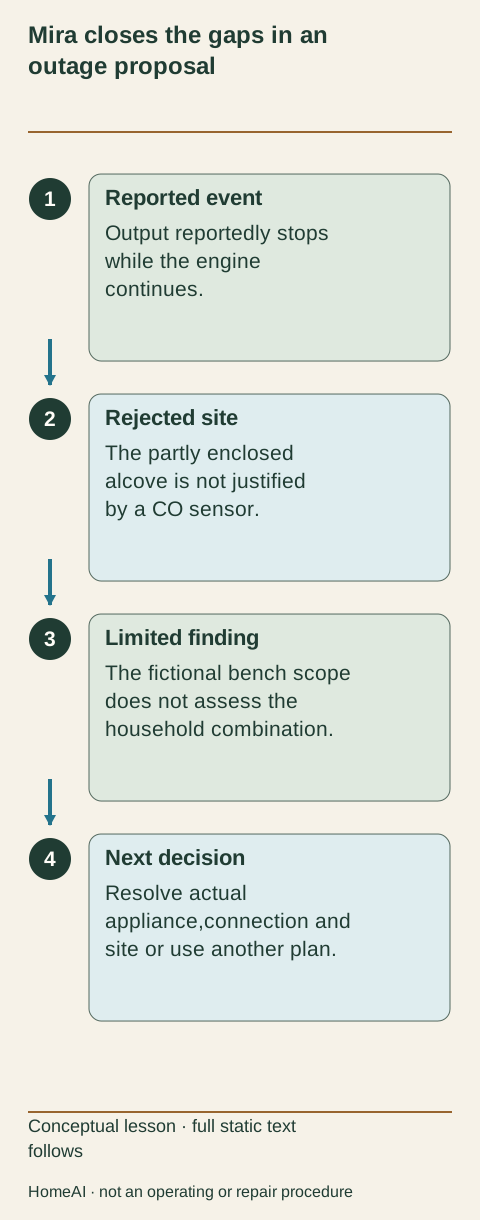
Mira closes the gaps in an outage proposal
Mira rejects the partly enclosed location and commissions separate equipment and intended-arrangement assessments. A limited bench finding does not answer the refrigerator start or the site.
Numbers identify the parts explained below.
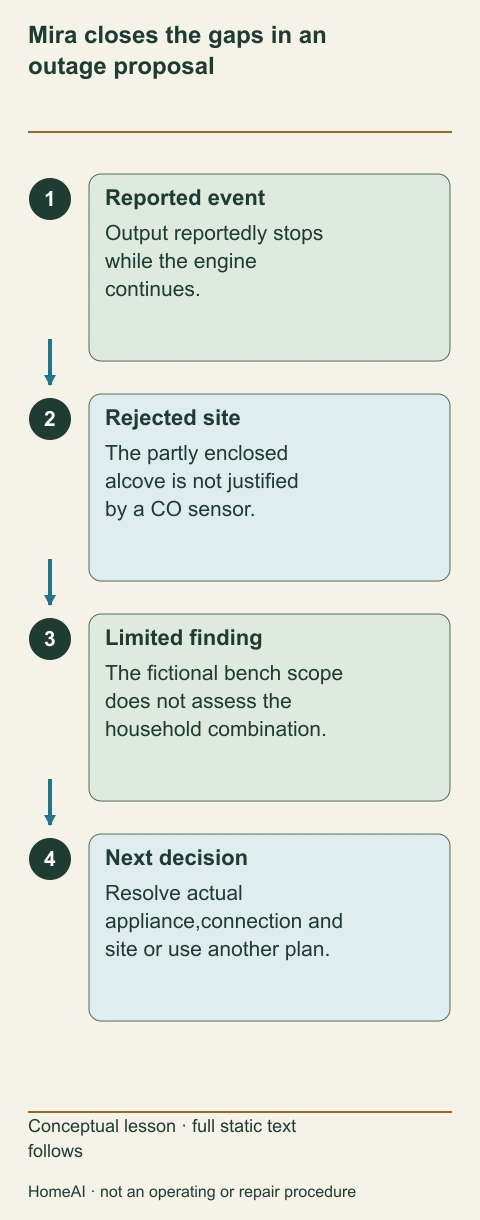
- Reported event
Output reportedly stops while the engine continues.
- Rejected site
The partly enclosed alcove is not justified by a CO sensor.
- Limited finding
The fictional bench scope does not assess the household combination.
- Next decision
Resolve actual appliance, connection and site or use another plan.
What does this illustration leave out?
Fictional household; no test result or readiness approval for real equipment. This illustration explains an idea. It is not an installation guide.
What remains unresolved after a narrowly successful service result?
Explore this with HomeAI ↗Opens an editable question. Nothing is sent until you choose to send it.Mira closes the gaps in an outage proposal
Mira rejects the partly enclosed location and commissions separate equipment and intended-arrangement assessments. A limited bench finding does not answer the refrigerator start or the site.
- Reported event
- Output reportedly stops while the engine continues.
- Rejected site
- The partly enclosed alcove is not justified by a CO sensor.
- Limited finding
- The fictional bench scope does not assess the household combination.
- Next decision
- Resolve actual appliance, connection and site or use another plan.
Figure scope: Fictional household; no test result or readiness approval for real equipment.
A useful question: What remains unresolved after a narrowly successful service result?
Full wording shown in this figure
- Mira closes the gaps in an
- outage proposal
- 1
- Reported event
- Output reportedly stops
- while the engine
- continues.
- 2
- Rejected site
- The partly enclosed
- alcove is not justified
- by a CO sensor.
- 3
- Limited finding
- The fictional bench scope
- does not assess the
- household combination.
- 4
- Next decision
- Resolve actual
- appliance,connection and
- site or use another plan.
- Conceptual lesson · full static text
- follows
- HomeAI · not an operating or repair procedure
What should be settled before the next outage?
Start with a named household function and a credible alternative, then match equipment and professional scopes to that need. The generator's engine, electrical output, protections, location, connection, fuel and storage all contribute different requirements. The plan is stronger when each unresolved item has a real next action, such as obtaining starting information or an electrician's defined assessment, rather than another generic ready label.
Canadian conditions differ by climate, housing, available outdoor space and local requirements. Shared-property rules, nearby buildings and winter weather may constrain a portable proposal. Health Canada's national CO prevention advice remains applicable context, while the actual authority and product instructions resolve the particular arrangement. A source read in October2026 does not make a 2020 manual a current rulebook for every model.
Use the related standby and outage lessons for their distinct questions, and keep CO warning and electrical protection as separate subjects. This guide's source record explains the named editions and adopted mechanisms. It offers no complete commissioning, owner fault test, enclosure design or guarantee of emergency supply. A well-understood limitation can lead to a better plan than equipment that seems impressive but cannot be used appropriately.
The practical takeaway is to follow the energy and the responsibilities together: fuel makes rotation, rotation supports electrical generation, the conversion and protection system manages the intended output, and qualified people resolve the actual site and connection. When those links are clear, an owner can ask precise questions and recognize when the safe next step is professional help or a different household option.
Keep learning about the connected parts
- Buying a home with a standby generator: engine, switching and handover
- A power outage plan for heating, water and communications
- Carbon monoxide and gas: what to do, and how prevention works
- Can this home support your electrical plans?
- Build a home-care record that the next person can understand
Canadian context and authorities · Visual atlas · Learning labs
Practice the distinction.
Mira’s refrigerator and an unusable sheltered site
Fictional learning example: output reportedly stops during a refrigerator start, and the proposed alcove is partly enclosed.
Reported observations
- The engine reportedly continues while output stops; no measured diagnosis is supplied.
- The appliance continuing information is retained, but starting information is missing.
- The partly enclosed site is rejected rather than justified by a CO sensor.
Compare the explanations
Expand each possibility to see the evidence needed to distinguish it. Similar symptoms can have different mechanisms.
The proposed load or connection is unsupported
Starting demand and the actual connection need assessment beyond a continuing rating.
Actual appliance information and a qualified assessment of the intended arrangement.
An equipment issue needs a defined service scope
The fictional bench result later finds no fault under its stated load, but does not assess the refrigerator or site.
Identified generator, reported event, scope and actual service findings.
A useful next question
Mira obtains the missing appliance information and intended-combination assessment, keeps a separate viable outage alternative, and uses no unsupported enclosed location.
Fictional decision; no actual load test, CO clearance, electrical approval or essential-service continuity guarantee.
Know what the words mean.
- Alternator
- The generator component that uses mechanical rotation to produce alternating electrical output.
- Rectifier
- An electrical conversion stage that changes alternating current into direct current in the named inverter architecture.
- Inverter
- An electrical stage that produces alternating output from direct current; actual output and protections remain product-specific.
- Rated output
- The manufacturer-stated continuing capacity under its specified conditions.
- Maximum output
- A different manufacturer limit; it is not a continuing household capacity.
- Starting demand
- The electrical demand associated with an appliance beginning operation, which may differ from its continuing demand.
- Apparent power
- An electrical quantity expressed in volt-amperes; it must not be silently substituted for real power in watts.
- Backfeed
- Electrical power taking an unintended route into utility or other wiring, with serious danger to people.
- CO shutoff
- A generator protective function responding near its sensor; it does not certify indoor air or an acceptable site.
- Cooling route
- The intended movement of air that removes equipment heat, distinct from combustion exhaust.
Questions to bring
to the conversation.
- Which exact generator and matching manual identify its architecture and protections?
- Which appliances, continuing and starting requirements were actually assessed?
- Can the actual outdoor site and weather arrangement meet all applicable requirements?
- Which connection, service and alternative household plan remain unresolved?
Separate a showing observation, an existing record and a new professional assessment. Unknown means a question remains; it does not automatically mean a defect.
Use the evidence planner ↗Go to the source.
Original HomeAI explanation informed by these public references. Sources support the underlying guidance; they have not reviewed or endorsed HomeAI. Diagrams are conceptual, and calculator outputs depend on your inputs.
Read October20, 2026 in America/Edmonton. Health Canada’s2022 backyard and2024 CO bodies supply national prevention advice. Honda’s2020 named manual and undated current inverter history have model/architecture limits; DENSO’s complete two-page chapter supplies basic automotive four-stroke physics only. HC6m guidance is not replaced by the manual’s shorter fire/cooling number. No site, connection, product listing, reset trial or whole-house readiness approval; worked household fictional.
Publication & source review
First published .
Sources reviewed .
Have a question about your home?
Start with the symptom, timing and what you have observed.
Ask HomeAI